Monday, June 4, 2012

Local drive-in theater


From the Santa Monica Public Library Image Archives and the Fred E. Basten Collection


The first drive-in movie theater opened in New Jersey in June 1933. The closest drive-in theater for Santa Monica residents was the Olympic Drive-In Theater located at Bundy and Olympic built in the 1940s. This was the first outdoor movie house in Southern California, a natural with our climate.

Monday, May 21, 2012

Noted African-American attorney, Walter L. Gordon, Jr. dies


Walter L. Gordon Jr., a pioneering African-American attorney, was born in Santa Monica on June 22, 1908 to Walter and Vertner Gordon.  According to his Los Angeles Time obituary, he attended USC and Ohio State University, where he earned his law degree. In 1937 he established a law practice on Los Angeles’ Central Avenue. One of the few African-American lawyers in California, he represented clients ranging from railroad dining car workers to jazz legend Billie Holiday. Among Mr. Gordon’s survivors is his son Walter L. Gordon III, an attorney. According to the Santa Monica City Directory for 1907, the year prior to Gordon’s birth, a man named Walter Gordon operated a shoeshine business on Pier Avenue.

Friday, April 27, 2012

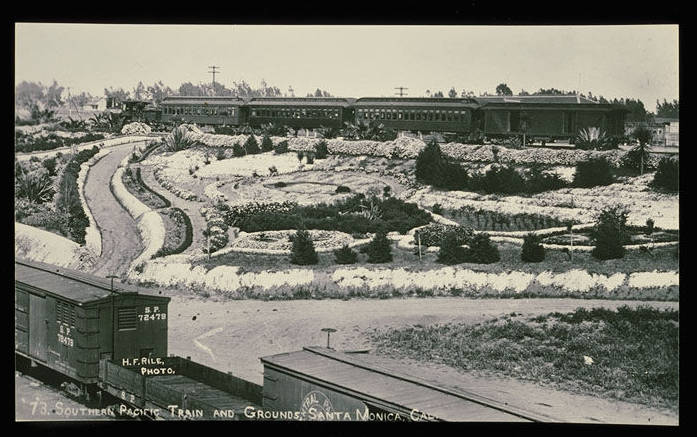
Southern Pacific in Santa Monica

Senator John P. Jones, half-owner of the land that became Santa Monica, developed a private steam powered rail service from the Long Wharf in Santa Monica to Los Angeles called the Los Angeles & Independent Railroad (LA & I) beginning in October 1875. The line was intended to expand over the Cajon Pass into San Bernardino and later to the Cerro Gordo mines in Panamint, near Death Valley.
Long Wharf Pier built by the Southern Pacific Railroad Company in 1893

Collins Potter Huntington, one of the Big Four who purchased Southern Pacific Railroad in 1868 was also interested in expanding in the same area under development by Senator Jones. Huntington vowed to "...cave him [Senator Jones] down the bank." Jones failed to realize expanding the private LA &I railroad line when he, like many other millionaires in 1876 was impacted by Black Friday, August 27, when Comstock speculations fell. Jones lost his fortune and ability to continue with construction. Southern Pacific agreed to build 25 miles of track to make Los Angeles a main-line station in exchange for  $600,00 in cash and bonds as well as the Los Angeles and San Pedro Railroads.
Southern Pacific Railroad train and grounds in Santa Monica in 1890

More images of the Southern Pacific Railroad in Santa Monica and Long Wharf are available in Imagine Santa Monica
To read more about Southern Pacific Railroad or the early days of railroads in America try:
American Railroads by John F. Stover, second edition 1997 Dewey 385 Stover 1997
Southern Pacific by Neill C. Wilson and Frank J. Taylor, c1952 Dewey 385 W
Sunset Limited: the Southern Pacific Railroad and the development of the American West, 1850-1930 by Richard J. Orsi, c2005 Dewey 385 Orsi

Monday, April 16, 2012

Depression Era building in Santa Monica

Three recognizable structures in Santa Monica were built as a part of the Works Project Administration (WPA) in the 1930s in which the New Deal agency funded and employed a million unskilled workers  who created public buildings; roads; large arts, drama and media projects; along with literacy projects throughout the country.

Pictured is Postmaster Phillip T. Hill at the dedication of the Santa Monica Post Office located at 1248 Fifth Street on July 23, 1938.


The auditorium named Barnum Hall was built with WPA funds for Santa Monica High School, following a devastating earthquake in 1933 that resulted in students attending classes in tents. Pictured are Santa Monica High School in 1930 and a view of the tents used for classes after the earthquake.


Santa Monica's City Hall located at 1685 Main Street was completed in 1938 and designed by architect Donald Parkinson in the Art Deco style.


Images are from the Imagine Santa Monica Image Archives


Monday, March 26, 2012

Garfield School, first in many ways in Santa Monica

Garfield Elementary School 1740 Seventh Street, Santa Monica

Garfield School began as an eight room, two story brick building serving grades one to eight in 1909, located at 7th and Michigan Streets. The school was notable from it's inception for the homogeneous student population. Students from "Spanish Hill" to the south, Chinese farm children north and east as well as African-American families, Italian, Japanese and Russian learned in a warm environment.

Firsts for Garfield included the first school cafeteria in town to provide warm milk and day-old bread supplied by local businesses. Using the school furnace as a cook-stove, women from the community made soup for nourishment for students without who could not bring lunch to school. Another first was the establishment of the first Parent Teacher Association (PTA) in the school district.

An experiment was tried to provide shower facilities for students whose families did not have adequete plumbing at their residences. The program was shut down as it was considered controversial by parents and other community members.

Innovation fueled development of student services at Garfield School when it was noted that student ages eight to eighteen continued to attend primary grades. Ungraded grammar grades where devised which offered what was considered opportunity training in skills such as gardening. A small plot of land was dedicated to growing vegetables. 

The neighborhood for Garfield School had a large number of working mothers which fueled the first kindergarten class in a Santa Monica School in the fall of 1913.

Under the leadership of Principal Josephine O'Leary, a new campus for the school was erected at 1811 16th Street in 1933, after an earthquake had made the original location unsafe. Americanization classes were offered at this new school for non-English speaking students.

Al Quinn and his wife Dottie, who was a long-time crossing guard for St. Anne's, were committed to providing wholesome activities and support for youth in the Santa Monica Community. Al Quinn, later Dr. Quinn upon completion of his PhD. in Sociology at UCLA, organized a youth activity center at Garfield Elementary School, that was used during the summer months by young people from schools all over Santa Monica. Monday through Friday programming included square dancing and sports activites. On Fridays it was movie day. There were crafts on the patio, hot dog parties and a unique toy-loan program. The Quinns began work with youth in the late 1940s and 1950s. Dr. Quinn was the first tenured African-American teacher in the Santa Monica School District.

The Quinn Research Center, a 501(c)(3) tax-exempt nonprofit organization, convened the Garfield @ 80 program to celebrate the remarkable student body and people who shaped Garfield Elementary School eighty years ago at the Thelma Terry Center in Virginia Park on Saturday, March 24. Attendees shared their recollections of the school and the Quinn's impact on the community. Carolyne Edwards gave a presentation with photos of her memories of the school and Dr. and Mrs. Quinn.

Sources consulted -

A History of the Santa Monica Schools: 1876-1951 by Donald M. Cleland

Lecture by Carolyne Edwards, Quinn Research Center on March 24, 2012 at the Thelma Terry Center in Virginia Park, Santa Monica, California
QuinnResearchCenter@gmail.com
Imagine Santa Monica (Santa Monica Digital Archives) created by Cynni Murphy, Librarian III

Saturday, March 17, 2012

Noir Images in the Library’s Image Archives: Notes from “Bay City and Beyond”

-Cynni Murphy, Librarian III, Image Archives LibrarianRaymond Chandler's "Bay City" (read Santa Monica) locale in the Lady and the Lake inspired a search for noir images in the Library DIgitial Archives. Setting the scene included searching concepts such as: mystery, darkness, shadows and light, bandleaders, movie stars, and Santa Monica icons like beach estates, hotels, the Santa Monica Pier and yacht harbor. The time frame primarily was the 1930s through the 1950s, but earlier images also provided influence.

Nicholas Christopher in his book on American Film Noir, Somewhere in the Night : Film Noir and the American City, wrote - "every American city is always a tale of two cities : the surface city imbued with customs and routine, and its shadow, the nether city, rife with darker impulses and forbidden currents, a world of violence and chaos...a dark mirror reflecting a dark underside of American life."

American Crime Fiction writers, such as Raymond Chandler and hard boiled detectives, inspired the images of film noir. Searching a collection of images for a theme inspires a particular visual point of view. Looking for noir elements: corridors or stairwells, rooftops, blind spots or the "edge of something dangerous."
Images selected from the Archives are available in Imagine Santa Monica

Night view of the coastline looking south to the Santa Monica Pier, 1929 (Security Pacific Bank Collection)
Archives #C69

Looking North on Fourth street Hensheys and Central Tower Building in a daytime view 1928. Hensheys 1925-1992 (Bldg demolished 1994). Tower Bldg. Art Deco built in 1929, M. Eugene Durfee Architect
Archives #B26

Night view of street lights looking toward the Richfield Gas Hotel Carmel and Central Tower Building from Colorado Avenue and Third Street, March 31, 1955. Hotel Carmel built in 1928, Kenneth Macdonald Jr. Architect
Archives #N214

Pier & Miramar Biltmore Beach Club in the foreground from the edge of the Palisades bluffs (photographed by Adelbert Bartlett 1927). Photographer for the Santa Monica Publicity Commission until WWII
Archives #C255

Coast Highway and Santa Monica Canyon (photographed by Adelbert Bartlett, 1935). “Altair Street lay on the edge of a V forming the inner end of a deep canyon. To the north was the cool blue sweep of the bay out to the point above Malibu to the south the beach town of Bay City was spread out on a bluff above the Coast Highway” – Raymond Chandler
Archives #C159

Iconic Santa Monica Pier merry-go-round La Monica Ballroom and Twin Racer roller coaster – amusements escape (Adelbert Bartlett, 1930) Pier originally built in 1909 at the end of Railroad Avenue (now Colorado) rebuilt 1920; Ballroom 15,000 square foot dance floor opened July 24, 1924 torn down 1963, Hippodrome Carousel built by I.D. Loof in 1916
Archives #D63

Twin Racer roller coaster ride on the Santa Monica Pier at night (photographed by Kenneth Strickfaden 1915) who was a Santa Monica electrician and photographer worked with “Frankenstein” director James Whale
Archives #D34

Del Mar Club elegant façade and doorway (photographed by Robert Ferguson, 1940s) luxurious beach clubs such as this were part of the culture, opened 1925 south of the Pier
Archives #A83

Façade of the Associated Telephone Company (later General Telephone) in Ocean Park on Marine Street ( Fred Basten Collection 1930s) “I went to the telephone and looked up the number of the police department in the directory. I dialed and while waiting for an answer I took the little automatic out of my pocket and laid it on the table beside the telephone.” – Raymond Chandler
Archives #A152

Cummings Buick, 1501 Santa Monica Blvd. - Automobile dealership of the era owned by Willard L. Cummings Sr. (originally a sales manager for C.S. Howard, owner of racehorse Seabiscuit), opened in 1937 (Photographed by Pacific Press, 1940s)
Archvies #A2011

Hotel Miramar (Adelbert Bartlett Circa 1940) elegant resort opened 1921. Named for SM founder John P. Jones home also called Miramar
Archives #A213

Marion Davies Santa Monica beach home and the Santa Monica Gold Coast (n.d.) - celebrity beach homes including Cary Grant, Harold Lloyd, Mac Sennett among others
Archives #PST67

Bandleader Tommy Tucker popular in the 1930s and 1940s (William Kane Family Collection, n.d.) - with a dedication to Jean and Eddie Kane of Eddie’s Chili Villa in the Canyon 1930s until the flood of 1938
Archives #G57

Portrait of famous Actress Gloria Stuart born in Santa Monica known for Noir Films such as “The Old Dark House,” directed by James Whale in 1932
Archives #F310

Anonymous beauty behind dark glasses, 1947 (Gilda and Midge Clark Family Collection)
Archives #F333

California Incline (1930s-1940s). Access road originally created from the bluffs to the beach at the turn of the century from Santa Monica Founder John P. Jones home Miramar
Archives #RY27

Breakers, Edgewater and the Del Mar beach clubs (photographed by Adelbert Bartlett, 1930s) Eleven different beach clubs were built by summer of 1927
Archives #C165

Staircase and dining room at the Kennedy residence, 329 23rd Street (Atchison Collection, n.d.) “ The house seemed to be abnormally still. I went along the rug and through the archway to the head of the stairs. I stood there for a moment and listened again. I shrugged quietly and went down the stairs.” – Raymond Chandler
Archives #A2019
Archives #A2016

WWII Camouflage of Douglas Aircraft Company by landscape architect Edward Huntsman-Trout (Museum of Flying Collection, 1941-1945). Camouflage constructed to conceal the manufacture of C47 transports and A20 attack bombers
Archived #I76

Santa Monica Yacht Harbor (photographed by Adelbert Bartlett, 1935) Breakwater built 1934. “Bay City was a very nice place. People lived her and thought so. If I lived here I would probably think so. I would see the nice blue bay and the cliffs and the yacht harbor” – Raymond Chandler
Archive #D67

Aerial of the Santa Monica Pier and the City (Spence Air Photos, March 20, 1932)
Archive #D116

Wednesday, February 8, 2012

Phillips Chapel Christian Methodist Episcopal Church


The corner stone for the first African-American church in Santa Monica was layed at 2001 4th Street in 1909. The building was moved from 4th and Ashland and believed to have been an old school house. The one and two story building has Colonial Revival style influences. It was remodeled in the 1940s with an addition for the price of $300, according to the October 10, 2005 Public Hearing to Consider Landmark Designation Application, created by the City of Santa Monica Planning Staff.


Originally named the Colored Methodist Episcopal Church by its founders in 1870, the denomination represented a break from the majority white governed Methodist Espiscopal Church that many slaves had been baptized in during the Civil War. A separate organization was created to so that the constituents could ordain their own ministers and bishops without permission. The name of the Church was changed to Christian Methodist Episcopal in 1953.