Friday, July 20, 2012

Edna Fisher, silent film actress, worked at Vitagraph Co. in Santa Monica

Edna Fisher, born Edna Levi in Nebraska on August 14, 1891 came to Hollywood and started making films at Vitagraph Company in 1911. Her filmography included 10 silent films and 5 film shorts between 1911 and 1912. A listing in the Santa Monica City Directory for 1912 shows her as an actress at Vitagraph Co, located at 1415 Ocean Avenue in Santa Monica. Miss Fisher was in several westerns including: "Broncho Billy's Adventure" produced in 1911. She married Rollin S. Sturgeon, who was a director for Vitagraph on September 26, 1912, which coincided with the end of her film career. They had five children. Miss Fisher died on April 23, 1978.


This article appeared in the The Daily Outlook on March 17, 1913
Source was the digitized Santa Monica Outlook Newspaper October 1875-May 1920, searchable in Imagine Santa Monica


This notice for extras for Vitagraph appeared in The Daily Outlook, February 21, 1914

Monday, July 16, 2012

Dame Christabel Pankhurst lived and died in Santa Monica at the end of her life

A notable suffragette from Great Britain, Dame Christabel Pankhurst, was born in 1880 to parent's Dr. Richard Pankhurst and Emmeline Pankhurst who were avid supporters of women's right to vote. Christabel accompanied her mother on speechmaking tours throughout England. They often were jailed for civil disobedience. Christabel was one of the first women in Britain to pass the bar examination.  She received the dame commander of the Order of the British Empire from King George V for her work helping to establish women's right to vote in England which transpired in 1918. Dame Pankhurst came to Canada and the United States in the 1930s to lecture at Bible conferences. She was an active member of the Episcopal Church.

According to her obituary in the February 14, 1958 Evening Outlook [on microfilm at the Santa Monica Public Library], Dame Pankhurst began living in Santa Monica around 1947. Some thought that she was attracted to Hollywood. She continued making speeches on occassion. She died sitting up in a chair in her apartment at 943 A Ocean Avenue in Santa Monica on February 13, 1958 at the age of 77. She was not ill at the time of her death.


Christabel Pankhurst was co-founder of The Suffragette a publication covering issues related to the women's movement


Dame Pankhurst is buried at Woodlawn Cemetery in Santa Monica

Monday, June 4, 2012

Local drive-in theater


From the Santa Monica Public Library Image Archives and the Fred E. Basten Collection


The first drive-in movie theater opened in New Jersey in June 1933. The closest drive-in theater for Santa Monica residents was the Olympic Drive-In Theater located at Bundy and Olympic built in the 1940s. This was the first outdoor movie house in Southern California, a natural with our climate.

Monday, May 21, 2012

Noted African-American attorney, Walter L. Gordon, Jr. dies


Walter L. Gordon Jr., a pioneering African-American attorney, was born in Santa Monica on June 22, 1908 to Walter and Vertner Gordon.  According to his Los Angeles Time obituary, he attended USC and Ohio State University, where he earned his law degree. In 1937 he established a law practice on Los Angeles’ Central Avenue. One of the few African-American lawyers in California, he represented clients ranging from railroad dining car workers to jazz legend Billie Holiday. Among Mr. Gordon’s survivors is his son Walter L. Gordon III, an attorney. According to the Santa Monica City Directory for 1907, the year prior to Gordon’s birth, a man named Walter Gordon operated a shoeshine business on Pier Avenue.

Friday, April 27, 2012

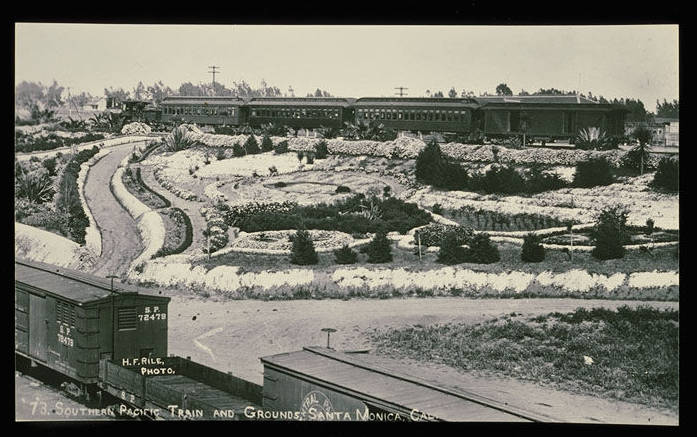
Southern Pacific in Santa Monica

Senator John P. Jones, half-owner of the land that became Santa Monica, developed a private steam powered rail service from the Long Wharf in Santa Monica to Los Angeles called the Los Angeles & Independent Railroad (LA & I) beginning in October 1875. The line was intended to expand over the Cajon Pass into San Bernardino and later to the Cerro Gordo mines in Panamint, near Death Valley.
Long Wharf Pier built by the Southern Pacific Railroad Company in 1893

Collins Potter Huntington, one of the Big Four who purchased Southern Pacific Railroad in 1868 was also interested in expanding in the same area under development by Senator Jones. Huntington vowed to "...cave him [Senator Jones] down the bank." Jones failed to realize expanding the private LA &I railroad line when he, like many other millionaires in 1876 was impacted by Black Friday, August 27, when Comstock speculations fell. Jones lost his fortune and ability to continue with construction. Southern Pacific agreed to build 25 miles of track to make Los Angeles a main-line station in exchange for  $600,00 in cash and bonds as well as the Los Angeles and San Pedro Railroads.
Southern Pacific Railroad train and grounds in Santa Monica in 1890

More images of the Southern Pacific Railroad in Santa Monica and Long Wharf are available in Imagine Santa Monica
To read more about Southern Pacific Railroad or the early days of railroads in America try:
American Railroads by John F. Stover, second edition 1997 Dewey 385 Stover 1997
Southern Pacific by Neill C. Wilson and Frank J. Taylor, c1952 Dewey 385 W
Sunset Limited: the Southern Pacific Railroad and the development of the American West, 1850-1930 by Richard J. Orsi, c2005 Dewey 385 Orsi

Monday, April 16, 2012

Depression Era building in Santa Monica

Three recognizable structures in Santa Monica were built as a part of the Works Project Administration (WPA) in the 1930s in which the New Deal agency funded and employed a million unskilled workers  who created public buildings; roads; large arts, drama and media projects; along with literacy projects throughout the country.

Pictured is Postmaster Phillip T. Hill at the dedication of the Santa Monica Post Office located at 1248 Fifth Street on July 23, 1938.


The auditorium named Barnum Hall was built with WPA funds for Santa Monica High School, following a devastating earthquake in 1933 that resulted in students attending classes in tents. Pictured are Santa Monica High School in 1930 and a view of the tents used for classes after the earthquake.


Santa Monica's City Hall located at 1685 Main Street was completed in 1938 and designed by architect Donald Parkinson in the Art Deco style.


Images are from the Imagine Santa Monica Image Archives


Monday, March 26, 2012

Garfield School, first in many ways in Santa Monica

Garfield Elementary School 1740 Seventh Street, Santa Monica

Garfield School began as an eight room, two story brick building serving grades one to eight in 1909, located at 7th and Michigan Streets. The school was notable from it's inception for the homogeneous student population. Students from "Spanish Hill" to the south, Chinese farm children north and east as well as African-American families, Italian, Japanese and Russian learned in a warm environment.

Firsts for Garfield included the first school cafeteria in town to provide warm milk and day-old bread supplied by local businesses. Using the school furnace as a cook-stove, women from the community made soup for nourishment for students without who could not bring lunch to school. Another first was the establishment of the first Parent Teacher Association (PTA) in the school district.

An experiment was tried to provide shower facilities for students whose families did not have adequete plumbing at their residences. The program was shut down as it was considered controversial by parents and other community members.

Innovation fueled development of student services at Garfield School when it was noted that student ages eight to eighteen continued to attend primary grades. Ungraded grammar grades where devised which offered what was considered opportunity training in skills such as gardening. A small plot of land was dedicated to growing vegetables. 

The neighborhood for Garfield School had a large number of working mothers which fueled the first kindergarten class in a Santa Monica School in the fall of 1913.

Under the leadership of Principal Josephine O'Leary, a new campus for the school was erected at 1811 16th Street in 1933, after an earthquake had made the original location unsafe. Americanization classes were offered at this new school for non-English speaking students.

Al Quinn and his wife Dottie, who was a long-time crossing guard for St. Anne's, were committed to providing wholesome activities and support for youth in the Santa Monica Community. Al Quinn, later Dr. Quinn upon completion of his PhD. in Sociology at UCLA, organized a youth activity center at Garfield Elementary School, that was used during the summer months by young people from schools all over Santa Monica. Monday through Friday programming included square dancing and sports activites. On Fridays it was movie day. There were crafts on the patio, hot dog parties and a unique toy-loan program. The Quinns began work with youth in the late 1940s and 1950s. Dr. Quinn was the first tenured African-American teacher in the Santa Monica School District.

The Quinn Research Center, a 501(c)(3) tax-exempt nonprofit organization, convened the Garfield @ 80 program to celebrate the remarkable student body and people who shaped Garfield Elementary School eighty years ago at the Thelma Terry Center in Virginia Park on Saturday, March 24. Attendees shared their recollections of the school and the Quinn's impact on the community. Carolyne Edwards gave a presentation with photos of her memories of the school and Dr. and Mrs. Quinn.

Sources consulted -

A History of the Santa Monica Schools: 1876-1951 by Donald M. Cleland

Lecture by Carolyne Edwards, Quinn Research Center on March 24, 2012 at the Thelma Terry Center in Virginia Park, Santa Monica, California
QuinnResearchCenter@gmail.com
Imagine Santa Monica (Santa Monica Digital Archives) created by Cynni Murphy, Librarian III